
Mobile Phone Laws While Driving Explained
Master Mobile Phone Laws whilst driving: The Construction and Use Regulations Guide
Mobile phone distraction remains one of the "fatal four" primary causes of serious road collisions in the UK (Snow, 2022). With the rules continuously tightening, relying on old myths about what is and isn't allowed behind the wheel can cost you your licence before your driving career even starts.
The primary piece of legislation governing this issue is Regulation 110 of the Road Vehicles (Construction and Use) Regulations 1986 (Snow, 2019). Over the years, loopholes have been firmly shut. Today, the law leaves absolutely zero room for ambiguity: any hand-held use of a mobile device while driving is an offence.
3 Key Takeaways: Mobile Phone Laws at a Glance
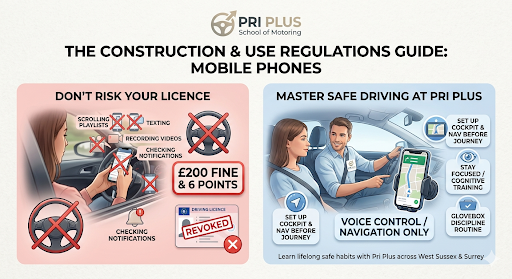
- The Zero-Tolerance Rule: It is illegal to hold or touch a mobile phone, sat-nav, or tablet for any standalone reason while driving—including scrolling playlists, checking the time, or taking photos. The old loophole requiring proof of an "interactive communication" is completely gone (Snow, 2022).
- The "Driving" Definition: The law applies whenever you are in control of the vehicle. This includes being stopped at traffic lights, waiting in stationary queues, or supervising a learner driver.
- The New Driver Penalty: If you are caught using a hand-held phone within the first two years of passing your test, you will receive 6 penalty points and an automatic ban, forcing you to reapply and pay for both your provisional licence and theory/practical tests all over again.
Decoding the Law: What is the Construction and Use Act?
Formally known as Regulation 110 of the Road Vehicles (Construction and Use) Regulations, this legislation dictates how motor vehicles must be built and operated safely on UK roads. Section 41D of the Road Traffic Act 1988 attaches strict criminal penalties to breaches of these construction and use requirements (Snow, 2019).
Historically, the law only penalised drivers if they were caught using a hand-held device for an "interactive communication function," such as sending a text or making a call (Snow, 2022). This led to high-profile legal challenges, such as DPP v Barreto [2019], where a driver escaped conviction under Regulation 110 because he was holding his phone solely to film a crash scene—an activity the court deemed non-interactive at the time (Snow, 2019).
To combat this, the law was comprehensively updated to close all loopholes. It is now explicitly illegal to hold a device to:
- Illuminate the screen or check notifications
- Scroll through music playlists or unlock the device
- Take photos, record videos, or stream media
- Play offline mobile games
Independent studies demonstrate that driving while distracted by a mobile phone impairs reaction times and hazard perception even more severely than operating a vehicle at the UK legal alcohol limit (Wells et al., 2021).
How We Train You to Stay Safe (and Legal) at Pri Plus
At Pri Plus School of Motoring, we don't just teach you how to pass the practical driving test; we use client-centered learning techniques to build safe driving habits that protect your licence for life.
Our specialised training syllabus directly tackles device temptation through targeted in-car modules:
1. Hands-Free Setup and In-Car Ergonomics
The Construction and Use Regulations do allow the use of hands-free devices (such as built-in Bluetooth or a phone securely mounted to a dashboard cradle). However, you must be able to operate it without touching the handset, and it must not obscure your view of the road. During your lessons, your Pri Plus instructor will show you how to properly set up your cockpit, program your sat-nav before starting the engine, and utilise voice activation safely.
2. Managing the Cognitive "Look But Fail to See" Phenomenon
Research confirms that drivers using phones are four times more likely to crash, frequently suffering from inattention blindness where they look directly at a hazard but fail to process it cognitively (Wells et al., 2021). We use open and closed questioning during our coaching sessions to help you evaluate your own mental focus, helping you understand how even a split-second glance at a screen completely shatters your hazard perception.
3. The "Glovebox Discipline" Routine
The easiest way to avoid a fine, points, or a crash is to remove the temptation entirely. We teach our students to build a routine around switching phones to "Do Not Disturb While Driving" mode and placing them securely out of sight and reach before the handbrake is lowered.
The Consequences: Protecting Your Hard-Earned Licence
The standard fixed penalty for breaching the Construction and Use Regulations regarding mobile phones is a £200 fine and 6 penalty points.
For experienced drivers, 6 points is a heavy blow. For a new driver, it is fatal to your mobility. Under the New Drivers Act, accumulating 6 or more points within 24 months of passing your test results in the immediate revocation of your driving licence.
Furthermore, if the police determine that your phone use caused erratic driving or led to an incident, you can be prosecuted for the far more severe offences of Careless Driving or Dangerous Driving, which carry hefty court-imposed fines, mandatory disqualifications, and potential prison sentences (Snow, 2019).
Ready to Build Safe, Lifelong Driving Habits?
Learning to drive is an investment in your independence. Don't let a phone notification take it away. At Pri Plus School of Motoring, our friendly, professional instructors across southern England ensure you understand the rules of the road inside out.
Give our friendly team a call today on 0333 772 9842 or find your local instructor to book your first lesson and take your first step toward a full UK driving licence.
Would you like to book a driving lesson with Pri Plus? - Yes
References
- Snow, A. J. (2019). Interactive Communication and Driving Does It Matter Whether It Is a Mobile or Camera Director of Public Prosecutions v Ramsey Barreto 2019 EWHC 2044 Admin.pdf. LJMU Research Online. https://researchonline.ljmu.ac.uk/11332/Cited by: 4
- Snow, A. (2022). Driving and use of a handheld mobile phone device - Bendt v Crown Prosecution Service Administrative. Criminal Law Review, 2022(6), 483-485. http://researchonline.ljmu.ac.uk/id/eprint/16733/Cited by: 0
- Wells, H., Briggs, G., & Savigar-Shaw, L. (2021). The Inconvenient Truth About Mobile Phone Distraction: Understanding the Means, Motive and Opportunity for Driver Resistance to Legal and Safety Messages. The British Journal of Criminology, 61(6), 1503-1520. https://doi.org/10.1093/bjc/azab038Cited by: 14